
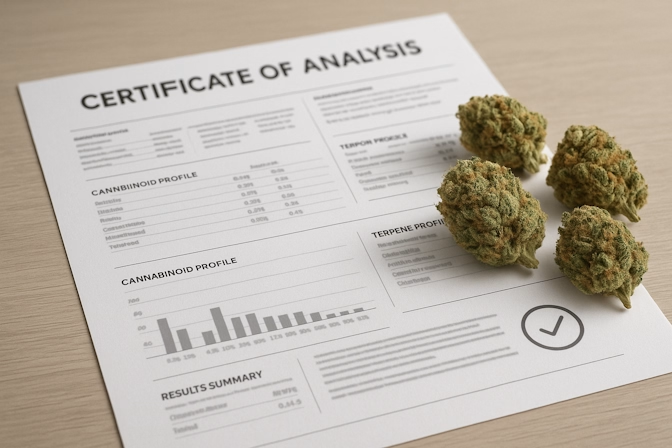
To read a Cannabis Certificate of Analysis (COA) like an industry expert, you need to check four main sections: the header metadata for batch verification, the safety panel for a clean pass on contaminants, the cannabinoid panel to calculate total active THC, and the terpene profile to determine taste, scent, and strain effects.
A Certificate of Analysis (COA) is an official laboratory document issued by an accredited third-party testing facility. It verifies the exact chemical composition of a cannabis product, proving whether a batch is potent, fresh, and free from dangerous pesticides, toxic heavy metals, residual solvents, or mold spores.
When you purchase premium smoke kind flower, concentrates, or edibles, reading the product COA is the only way to confirm you are consuming clean, safe, high-grade kind weed. This master guide walks you step-by-step through decoding lab results, calculating true potency, spotting red flags, and verifying product purity.
What Is a Cannabis Certificate of Analysis (COA) and Why Is It Essential?
A Cannabis Certificate of Analysis (COA) is an audited quality control report generated by an independent analytical testing laboratory. It measures two primary categories: potency (cannabinoids and terpenes) and safety (contaminants and unwanted biological or chemical pollutants).
                     +---------------------------------------+
                     |        CANNABIS COA LAB REPORT        |
                     +---------------------------------------+
                                         |
         +-------------------------------+-------------------------------+
         |                               |                               |
         v                               v                               v
+-----------------+             +-----------------+             +-----------------+
|    HEADER &     |             |   CANNABINOID   |             |    CONTAMINANT  |
|  METADATA PANEL |             | & TERPENE PANEL |             |   SAFETY SCREEN |
+-----------------+             +-----------------+             +-----------------+
| • Lab Accreditation           | • Active Cannabinoids          | • Heavy Metals   |
| • Batch / Lot Match           | • Total THC Formula            | • Pesticides    |
| • Sample Date                 | • Terpene Content %            | • Microbials    |
| • License Numbers             | • Minor Compounds              | • Residual Solvents
+-----------------+             +-----------------+             +-----------------+
In the legal cannabis industry, third-party lab testing bridges the gap between producer marketing and actual consumer safety. Packaging can feature sleek designs and claims of exceptional potency, but the raw laboratory data reveals the real story of what is inside the jar.
The Role of COAs in Consumer Safety and Product Purity
Cannabis plants are natural bioaccumulators—their root networks draw up elements, minerals, and compounds directly from the surrounding soil and groundwater. If a farm uses poor soil containing heavy metals, or if a nearby field sprays agricultural runoff, those toxins accumulate inside the plant tissue and trichomes.
Without strict cannabis testing, these pollutants pass into the finished smoke, vapor, or edible matrix. A comprehensive COA acts as a safety gate, ensuring that the kind smoke you purchase is free from:
Toxic heavy metals like lead, arsenic, and mercury
Synthetic chemical pesticides and fungicides
Harmful mold spores, such as Aspergillus
Chemical solvent residues left behind during concentrate extraction
Why Marketing Labels Are Not Enough
Relying solely on dispensary package labels leaves critical blind spots:
Inaccurate Potency Numbers: Marketing materials often round up numbers or highlight raw precursor values (like THCa) instead of decarboxylated, active THC.
Lack of Contaminant Details: Space on a small jar label is limited; it rarely lists specific pesticide or heavy metal detection limits.
Lack of Genetic Standardization: Cultivators may sell different genetics under popular strain names. The COA provides the actual terpene and cannabinoid breakdown regardless of the strain name on the sticker.
Section-by-Section Guide: How to Read a COA
While testing laboratories use different visual layouts, every compliant COA cannabis document follows a standardized logical structure.
Header and Metadata Verification (The “Match Test”)
Before looking at THC metrics or terpene graphs, start at the top banner of the document. This section establishes the legal chain of custody and verifies that the lab report matches the exact product in your hand.
+---------------------------------------------------------------------------------+
| SAMPLE NAME: Super Lemon Haze Flower            BATCH NUMBER: SLH-2026-0811-A    |
| PRODUCER: Kind Cannabis Cultivation             TEST DATE: August 14, 2026        |
| LAB NAME: Apex Analytical Laboratories          ISO CERTIFICATION: ISO/IEC 17025  |
+---------------------------------------------------------------------------------+
1. Batch / Lot Number Verification
Find the batch or lot code printed on your physical product package and compare it against the batch code listed on the COA. If these codes do not match, the document applies to a completely different batch, making the report useless for verifying your product.
2. Test Date and Harvest Date
Review when the sample was tested. Cannabinoids and terpenes degrade over time when exposed to heat, light, and oxygen. A COA older than six months for flower, or older than twelve months for concentrates, may no longer reflect the actual potency or aroma profile of the product.
3. Laboratory Credentials & License Information
Verify that the lab report displays an official license number and accreditation stamp. Look specifically for ISO/IEC 17025 accreditation. This international certification guarantees that the testing facility adheres to rigorous calibration protocols, precise analytical methods, and regular scientific audits.
Cannabinoid Profiles: Deciphering True Potency
The cannabinoid potency panel measures the concentration of active and inactive compounds in the sample. Understanding this panel requires looking past simple percentages to analyze how these compounds behave when heated.
+---------------------------------------------------------------------------------+
| ANALYTE           | WEIGHT %    | MASS (mg/g) | LOD (%)     | LOQ (%)           |
+---------------------------------------------------------------------------------+
| THCA              | 28.45%      | 284.50      | 0.01        | 0.05              |
| Delta-9 THC       | 0.82%       | 8.20        | 0.01        | 0.05              |
| CBGA              | 1.15%       | 11.50       | 0.01        | 0.05              |
| CBG               | 0.22%       | 2.20        | 0.01        | 0.05              |
| CBD               | ND          | ND          | 0.01        | 0.05              |
| CBC               | 0.18%       | 1.80        | 0.01        | 0.05              |
+---------------------------------------------------------------------------------+
| TOTAL THC (CALC)  | 25.77%      | 257.70      | PASS        |                   |
+---------------------------------------------------------------------------------+
Units of Measurement: % vs. mg/g vs. mg/unit
Testing laboratories express cannabinoid content using three standard measurements:
| Measurement Unit | Typical Product Application | Meaning |
| Weight Percentage (%) | Dried Flower, Prerolls, Concentrates | Grams of cannabinoid per 100 grams of plant material. |
| Milligrams per Gram (mg/g) | Bulk Concentrates, Rosin, Distillate | Milligrams of cannabinoid per single gram of product. |
| Milligrams per Unit (mg/unit) | Edibles, Tinctures, Beverages, Capsules | Total cannabinoid mass in a single packaged serving or item. |
Conversion Shortcut: To convert $\text{mg/g}$ into a weight percentage, divide by 10. For example, a batch of concentrate containing $240\text{ mg/g}$ of THCa equals $24.0\%$ THCa by weight.
Raw THCa vs. Active Delta-9 THC
A common source of confusion when reading test results cannabis reports is the distinction between THCa (Tetrahydrocannabic Acid) and Delta-9 THC.
Raw cannabis plants synthesize THCa, an acidic precursor that is non-intoxicating in its natural state. When exposed to heat—such as a lighter flame, a vaporizer heating element, or an oven—THCa undergoes decarboxylation. Heat removes a carboxyl group ($-\text{COOH}$) from the molecule, releasing carbon dioxide ($CO_2$) and converting non-intoxicating THCa into psychoactive Delta-9 THC.
       Heat / Decarboxylation (Heat > 220°F / 104°C)
  THCA --------------------------------------------> Delta-9 THC + CO2
(Non-Intoxicating)                                 (Intoxicating)
Because of this reaction, fresh cured flower contains high THCa percentages with minimal active Delta-9 THC (often below $1.0\%$) prior to heating.
The Mathematical Formula for Total Active THC
You cannot find total potency by simply adding raw THCa and Delta-9 THC together. Because decarboxylation sheds a portion of the molecule’s mass, THCa yields approximately $87.7\%$ of its original weight as active Delta-9 THC.
Labs use this standardized mathematical equation to calculate true potency:
Practical Calculation Example:
If a lab report lists:
THCa: $28.45\%$
Delta-9 THC: $0.82\%$
Multiply the raw THCa percentage by the molecular conversion factor:
$$28.45\% \times 0.877 = 24.95\%$$Add the active Delta-9 THC value:
$$24.95\% + 0.82\% = 25.77\%$$True Total Active THC = $25.77\%$
If a brand prints “$29.27\%$ THC” on its packaging by adding $28.45 + 0.82$ directly, it is inflating its potency metrics and ignoring the chemical loss that occurs during heating.
Major vs. Minor Cannabinoid Breakdown
While Delta-9 THC produces the primary psychoactive effect, minor cannabinoids work together to refine the overall experience:
CBG / CBGa (Cannabigerol): Often called the “mother cannabinoid” because its acidic form (CBGa) serves as the building block for THCa, CBDa, and CBCa. High-grade kind weed often contains $1.0\%\text{–}3.0\%$ CBG, which contributes to a balanced, smooth experience.
CBD / CBDa (Cannabidiol): A non-intoxicating compound widely valued for its calming properties. It tempers the intense psychoactive impact of high THC doses.
CBN (Cannabinol): Formed when THC degrades due to oxygen, heat, or light exposure. Freshly cured flower should show minimal CBN. If a COA reveals CBN levels above $1.0\%$, the batch is likely old or stored improperly.
CBC (Cannabichromene): A non-intoxicating minor cannabinoid that supports the entourage effect by enhancing overall cannabinoid performance.
Terpenes: aroma, Flavor, and Strain Character
For years, many buyers assumed that high THC percentages were the sole indicator of product quality. Modern plant science proves that terpenes—the aromatic organic compounds found inside trichomes—drive the unique scent, flavor, and distinct effects of each strain.
A complete how to read cannabis certificate of analysis guide must evaluate terpene profiles. Premium growers cultivating genuine kind smoke focus on maximizing terpene content ($2.0\%\text{–}5.0\%+$) rather than chasing inflated THC numbers alone.
                    TOTAL TERPENE CONTENT GUIDE

[ < 1.0% ] ------------------> Low aroma, harsh smoke, rushed cure
[ 1.5% - 2.5% ] -------------> Standard quality dispensary flower
[ 2.5% - 4.0%+ ] ------------> Exceptional craft quality, rich flavor profile
Key Terpenes to Look For on a COA
Reviewing the terpene panel reveals the dominant aromatic compounds and subtle effects of a strain:
+---------------------------------------------------------------------------------+
| TERPENE ANALYTE      | WEIGHT %    | MASS (mg/g) | AROMA / EFFECT PROFILE       |
+---------------------------------------------------------------------------------+
| Beta-Myrcene         | 1.12%       | 11.20       | Earthy, Herbal / Sedating    |
| Limonene             | 0.65%       | 6.50        | Citrus, Sour / Uplifting     |
| Beta-Caryophyllene   | 0.48%       | 4.80        | Pepper, Spice / Comforting   |
| Alpha-Pinene         | 0.21%       | 2.10        | Sharp Pine / Focus           |
| Linalool             | 0.15%       | 1.50        | Floral, Lavender / Relaxing  |
+---------------------------------------------------------------------------------+
| TOTAL TERPENES       | 2.61%       | 26.10       | EXCELLENT                    |
+---------------------------------------------------------------------------------+
Beta-Myrcene
Aroma: Earthy, herbal, clove-like.
Effects: Deep physical relaxation, calming sensations.
COA Insight: Strains testing over $0.5\%$ Myrcene typically deliver deeply relaxing physical effects.
Limonene
Aroma: Bright citrus, sweet lemon, sour orange.
Effects: Mood elevation, mental focus, refreshing feel.
COA Insight: Limonene is highly volatile; high levels indicate careful harvesting, gentle curing, and cold-chain storage.
Beta-Caryophyllene
Aroma: Spicy, cracked black pepper, warm wood.
Effects: Soothing physical comfort, stress reduction.
COA Insight: Caryophyllene acts as both a terpene and a cannabinoid, directly binding to CB2 receptors in the body.
Alpha- & Beta-Pinene
Aroma: Fresh pine, rosemary, forest canopy.
Effects: Mental clarity, alertness, refreshed focus.
COA Insight: Pinene helps balance memory haze sometimes caused by high doses of THC.
Linalool
Aroma: Delicate floral, fresh lavender, light citrus.
Effects: Peaceful relaxation, gentle stress relief.
COA Insight: Present in smaller amounts; concentrations between $0.2\%\text{–}0.4\%$ soften intense psychoactive experiences.
Evaluating Total Terpene Percentages
Always add the individual terpene bars together to calculate total percentage:
Under $1.0\%$ Total Terpenes: Indicates muted flavor, weak aroma, or improper drying and handling.
$1.5\%\text{–}2.5\%$ Total Terpenes: Solid dispensary-grade quality.
Over $3.0\%$ Total Terpenes: Exceptional craft quality smoke kind flower with rich aroma, mouth-coating flavor, and a deep, multi-layered effect.
Safety Panels: Screening for Hidden Contaminants
While cannabinoid and terpene charts receive the most attention, the contaminant safety panel is the most important section for protecting your health. This section verifies that the product passed mandatory health and safety thresholds.
Compliant legal markets mandate full-panel safety testing. If a vendor only provides a potency chart and omits the safety panels, do not purchase the product.
+---------------------------------------------------------------------------------+
| CONTAMINANT PANEL      | METHODOLOGY   | STATUS   | ACTION LIMIT | RESULTS      |
+---------------------------------------------------------------------------------+
| Heavy Metals           | ICP-MS        | PASS     | State MRL    | < LOQ        |
| Pesticides             | LC-MS/MS      | PASS     | State MRL    | ND           |
| Microbials             | qPCR          | PASS     | Absence/1g   | Absent       |
| Residual Solvents      | GC-MS         | PASS     | State MRL    | ND           |
| Mycotoxins             | LC-MS/MS      | PASS     | 20 ppb       | < LOD        |
+---------------------------------------------------------------------------------+
1. Heavy Metals
Because cannabis absorbs minerals from the soil, accredited labs screen for the “Big Four” toxic heavy metals using Inductively Coupled Plasma Mass Spectrometry (ICP-MS):
Lead (Pb)
Arsenic (As)
Cadmium (Cd)
Mercury (Hg)
The report should display a clear PASS mark. Values should read ND (Not Detected) or $<\text{LOQ}$ (Below Limit of Quantitation).
2. Agricultural Pesticides & Fungicides
Cultivators occasionally use synthetic sprays like Myclobutanil, Bifenthrin, or Avermectin to combat powdery mildew or mites during growth. When burned, chemical compounds like Myclobutanil decompose into toxic gases.
Testing labs screen for these compounds using Liquid Chromatography-Mass Spectrometry (LC-MS/MS) or Gas Chromatography-Mass Spectrometry (GC-MS/MS). Clean kind weed should test completely free from pesticide residues.
3. Microbial Contaminants and Mold Spores
Microbial panels detect harmful mold, yeast, and bacteria that multiply during improper drying or curing:
Aspergillus (flavus, fumigatus, niger, terreus): Dangerous mold species capable of causing lung infections.
Shiga toxin-producing E. coli & Salmonella: Pathogenic bacteria resulting from contaminated water sources or unhygienic facilities.
Total Yeast & Mold Count (TYMC): Measured in Colony Forming Units per gram ($\text{CFU/g}$).
State regulations mandate a strict “Absence in 1 gram” standard for pathogenic species.
4. Moisture Content and Water Activity ($a_w$)
Proper moisture control keeps flower fresh and prevents mold growth:
Moisture Content: The optimal range is $10\%\text{–}13\%$. Moisture above $15\%$ leaves flower overly wet and susceptible to mold in sealed jars. Moisture below $8\%$ makes flower brittle and harsh to smoke.
Water Activity ($a_w$): Measures unbound moisture available for microbial growth. Safety standards require water activity levels below $0.65\text{ }a_w$ to ensure long-term shelf stability.
5. Residual Solvents (Extracts & Concentrates)
Concentrates like resin, shatter, and vape oils often use chemical solvents like butane, propane, or ethanol to extract cannabinoids. Processors purge these solvents using vacuum ovens.
The residual solvent panel confirms that all extraction chemicals were safely removed:
Solventless Concentrates (Live Rosin, Ice Water Hash) use heat, ice, and mechanical pressure, making them naturally free of residual solvent risks.
Solvent Extracts (BHO, Distillate) must test well below state action thresholds (typically $<100\text{ ppm}$ for residual butane or ethanol).
Red Flags: How to Spot Inaccurate or Manipulated Data
As demand for high-potency products has grown, some suppliers and dishonest labs attempt to manipulate testing data. Knowing how to spot bad data protects you from purchasing mislabeled or contaminated products.
┌─────────────────────────────────────────────────────────────────┐
│                    COA RED FLAG CHECKLIST                       │
├─────────────────────────────────────────────────────────────────┤
│ [!] Missing Safety Panels (Only Potency Shown)                  │
│ [!] Unrealistic THC Numbers (38% - 45% Flower Potency)          │
│ [!] Mismatched Batch Codes Between Package & COA                │
│ [!] Outdated Test Dates (> 6 to 12 Months Old)                  │
│ [!] "PASS" Checks Applied over High Contaminant Numbers         │
│ [!] No ISO/IEC 17025 Lab Accreditation Badge                    │
└─────────────────────────────────────────────────────────────────┘
1. “THC Inflation” and Lab Shopping
Lab shopping occurs when a vendor sends samples to multiple labs and only publishes results from the facility returning the highest THC numbers.
Dried cannabis flower caps out at around $33\%\text{–}35\%$ total cannabinoids by dry weight. The remaining plant mass consists of cellulose, lipids, proteins, terpenes, and moisture. If a standard flower sample displays $40\%$ or $45\%$ THC without kief coating or concentrate infusion, the lab is likely manipulating dry-weight figures or inflating data.
2. Potency-Only Reports
Some vendors share a one-page document showing cannabinoid percentages while hiding or omitting the safety panels. A potency summary is not a complete COA. If a brand refuses to share pesticide, heavy metal, and mold testing, assume the batch failed safety screenings.
3. Understanding LOD, LOQ, and ND Definitions
Pay attention to the technical abbreviations in lab tables:
LOD (Limit of Detection): The lowest concentration of a substance the lab’s instruments can detect.
LOQ (Limit of Quantitation): The lowest concentration that can be accurately measured and reported.
ND (Not Detected): The target contaminant was not found above the Limit of Detection.
$<\text{LOQ}$: Trace amounts were detected, but they fell below the minimum threshold required for precise measurement.
0.00% ─────── [ Limit of Detection (LOD) ] ─────── [ Limit of Quantitation (LOQ) ] ───────> Higher Concentration
                 |                                    |
                 +--> Results = "ND"                  +--> Results = "< LOQ"
                     (Zero traces detected)               (Trace amount detected, but too low to measure)
Be cautious if a lab sets its LOD/LOQ limits unusually high. High detection thresholds allow trace toxins to remain hidden while still passing standard reporting checks.
To review official state testing guidelines, compliance standards, and regulatory requirements, check official state resources like the California Department of Cannabis Control (DCC) or the Massachusetts Cannabis Control Commission (CCC).
Step-by-Step Practical Checklist for Consumers
Follow this quick four-step process to evaluate a COA when shopping online or reviewing product QR codes:
  +-----------------------------------------------------------------------+
  | STEP 1: METADATA MATCH                                                |
  | Verify Batch Code, Check Test Date (<6 mos), Confirm ISO Accreditation|
  +-----------------------------------------------------------------------+
                                      |
                                      v
  +-----------------------------------------------------------------------+
  | STEP 2: SAFETY AUDIT                                                  |
  | Confirm Overall "PASS" Status Across Metals, Pesticides, & Microbials |
  +-----------------------------------------------------------------------+
                                      |
                                      v
  +-----------------------------------------------------------------------+
  | STEP 3: POTENCY EVALUATION                                            |
  | Calculate Total THC: (THCa × 0.877) + Delta-9 THC                     |
  +-----------------------------------------------------------------------+
                                      |
                                      v
  +-----------------------------------------------------------------------+
  | STEP 4: TERPENE & CURING PROFILE                                      |
  | Target 2.0%+ Total Terpenes, Review Top 3 Terpenes for Effect Profile |
  +-----------------------------------------------------------------------+
Step 1: Perform the Metadata Match
Scan the top header. Confirm that the batch code matches your packaging, verify the test date is recent, and make sure the facility holds valid ISO/IEC 17025 accreditation.
Step 2: Perform the Safety Audit First
Skip the THC section initially and check the safety summary page. Confirm that every category displays a PASS mark and that heavy metals, pesticides, and microbial screens read ND or $<\text{LOQ}$.
Step 3: Calculate Honest Total Active THC
Review the cannabinoid table. Check raw THCa and Delta-9 THC numbers, then apply the standard formula:
Check minor cannabinoids like CBG and CBD to evaluate the full profile.
Step 4: Evaluate Terpenes and Curing Metrics
Inspect the terpene section. Look for total terpene content of $2.0\%$ or higher. Review the dominant terpenes to understand the strain’s aroma and effect profile, then confirm that moisture content sits cleanly between $10\%\text{ and }13\%$.
Quick Reference Evaluation Table
| Section | Target Value / Ideal Result | Potential Red Flag |
| Batch Info | Matches package label exactly; test date $<6$ months old. | Missing batch numbers or test dates $>12$ months old. |
| Lab Accreditation | ISO/IEC 17025 stamp with valid license number. | Unaccredited lab or missing facility credentials. |
| Safety Summary | Clear “PASS” across all contaminant panels. | “Potency-Only” report with missing safety data. |
| THC Calculation | Mathematically verified: $(\text{THCa} \times 0.877) + \Delta^9\text{-THC}$. | Raw flower claims exceeding $35\%$ THC without concentrate infusion. |
| Terpene Profile | $2.0\%\text{–}4.0\%+$ total terpene content. | $<1.0\%$ total terpenes or missing terpene breakdown. |
| Microbials & Mold | “Absent in 1 gram” for Aspergillus, E. coli, and Salmonella. | Active microbial presence or high yeast/mold counts. |
| Moisture Content | $10\%\text{–}13\%$ for cured flower; water activity $<0.65\text{ }a_w$. | Moisture $>15\%$ (mold risk) or $<8\%$ (overly dry). |
Final Thoughts: Demand Complete Lab Transparency
Knowing how to read a Cannabis Certificate of Analysis (COA) gives you full confidence in your purchase decisions. You no longer have to rely on marketing hype or packaging claims alone.
True product quality is clearly visible in the lab data. By verifying batch numbers, calculating true decarboxylated THC levels, checking terpene ratios, and insisting on clean safety screenings, you ensure that every product you buy is safe, potent, and high quality.
The next time you select your favorite kind smoke, scan the QR code on the jar. Run through this four-step checklist, verify the lab results, and enjoy pure kind weed with total peace of mind.